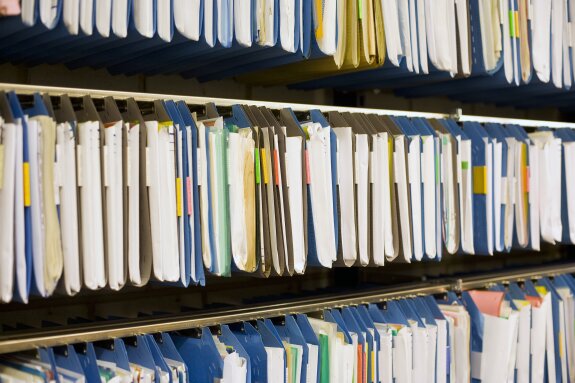
What is a digital personnel file?
A digital personnel file is a system in which an employee’s personnel documents are managed electronically in a central location. This eliminates the need for paper files and scattered storage systems.
These may include, for example, employment contracts, contract amendments, references, certificates, evidence of further training, driving licences, criminal record checks or other personnel-related documents.
A standardised file structure ensures that information can be found quickly and is not scattered across different drives, email inboxes or paper files.
However, a modern digital personnel file can do even more: follow-up reminders, notifications and self-service functions transform it from a simple document repository into a tool for day-to-day HR work.
What should be included in a digital personnel file?
In principle, a digital personnel file can contain any documents and information required in connection with an employment relationship. Typical contents include:
- Employment contract and contract amendments
- Application documents and CV
- References and proof of qualifications
- Certificates and evidence of further training
- Driving licences and other necessary documentation
- Certificates of good conduct, where these are required for the relevant role
- Warnings and other employment-related documents
- Correspondence and other employee-related documents
Naturally, the relevant data protection and legal requirements must be taken into account. This is precisely why clearly defined access rights are particularly important when it comes to digital personnel files.
Why is it worth digitising personnel files?
Less paper is an obvious advantage. However, the real benefit becomes apparent in day-to-day workflows.
Personnel documents can be accessed immediately without having to search through a filing cabinet. Several authorised individuals can access the documents they need, regardless of where they are working.
This benefit becomes particularly apparent when staff are working from home or a company has multiple sites.
What’s more, in a digital personnel file, documents can not only be stored but also linked to deadlines and follow-up reminders. This means the HR department no longer has to keep track of when a certificate needs to be renewed or requested again.
Data protection plays a particularly important role in relation to personnel files
Personnel files contain sensitive personal data. It is therefore vital to restrict access to them in a targeted manner.
A digital personnel file should therefore offer a nuanced access rights model. Not every user should automatically be able to view all of an employee’s documents. Roles and permissions make it possible to control access in line with the specific task at hand.
This also applies to self-service: employees should be able to use the documents and functions intended for them without thereby gaining access to information that is reserved exclusively for the HR department.
Find documents more quickly instead of spending ages searching
Another advantage is the structured filing system. Documents are assigned directly to the relevant person and the appropriate section of the personnel file.
This makes it easy, for example, to see at a glance which contracts, certificates or other documents are on file for a particular employee.
A standardised structure also makes work within the HR department easier – particularly when several people are working with the files.
Instead of searching for documents in different directories, email inboxes or paper files, a quick glance at the digital personnel file is all it takes.
Integrating digital personnel files with HR management
A digital personnel file becomes particularly useful when it is not operated as an isolated document archive.
With SaaS.de HR, the personnel file is integrated directly into the HR management system. Employee data and associated documents are thus managed in one central location.
Additional functions such as time and attendance tracking, leave management and travel expenses can be utilised within the same solution.
This means that documents are not managed in isolation from the relevant employee, but form part of their digital personnel file. Follow-up reminders and self-service functions complement this centralised management with automated processes.
Existing personnel files can also be digitised
The transition does not necessarily mean that all existing personnel files have to be digitised overnight.
Existing documents can be digitised in stages and assigned to the relevant employees. For new documents, the need for paper filing will then gradually be phased out.
In this way, the traditional personnel file can be gradually replaced by a digital personnel file.
Such a phased approach is particularly suitable for small and medium-sized enterprises that wish to modernise their HR administration without undertaking a major digitalisation project.
From filing to digital HR processes
The greatest advantage of a digital personnel file lies not merely in replacing paper with PDF files.
It is only through features such as structured filing, access rights, follow-up reminders, automatic reminders and employee self-service that end-to-end digital processes are created.
A document is not simply stored. The system can remind users when action is required, and employees can submit the necessary documents themselves.
In this way, the digital personnel file reduces administrative workload and relieves the HR department of recurring tasks.
Digital personnel file with SaaS.de
The digital personnel file is an integral part of SaaS.de HR and links document management with other areas of digital HR.
Companies can manage HR documents centrally and in a structured manner, control access and use follow-up reminders. In conjunction with self-service functions, employees can be actively involved in processes and provide the necessary documents themselves.
Together with time tracking, leave management, travel expenses and other functions, this creates a centralised HR management system tailored to the company’s actual requirements.
Less paper, less searching, fewer enquiries – and all key HR documents in one central location.
Read next week: How automated follow-ups and self-service take the strain off the HR department when it comes to recurring tasks.
Don’t want to miss the next post? Sign up for our newsletter.