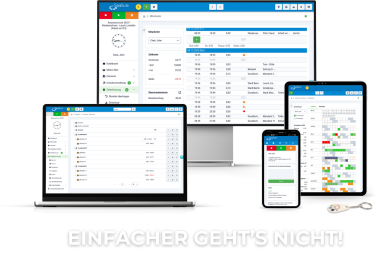
Working on Sundays and public holidays is essential in many sectors – whether in the healthcare sector, the hospitality industry or the retail sector. But what premium rates apply, how are they treated for tax purposes, and how can they be efficiently accounted for? This article clarifies the key questions and shows how SaaS.de simplifies the payroll processing of public holiday premiums.
Legal basis: What does the Working Hours Act (ArbZG) say?
The Working Hours Act (ArbZG) stipulates that, as a general rule, employees may not be required to work on Sundays and public holidays. Exceptions are, however, possible, for example in sectors critical to the functioning of society or where there are specific operational requirements. Important to note:
- No statutory entitlement to premiums: The ArbZG itself does not specify fixed percentages for Sunday or public holiday premiums. An entitlement arises only from collective agreements, employment contracts or established company practice.
- Obligation to provide compensation: Appropriate compensation must be granted for work carried out on Sundays and public holidays, e.g. paid time off or a financial allowance.
Usual premium rates in practice:
- Sunday work: In many sectors, a 50 per cent premium on the basic wage is standard.
- Work on public holidays: On statutory public holidays (e.g. Easter Monday, Whit Monday, 1 May), a 125 per cent premium is often paid – provided this has been agreed.
- Combination: If a public holiday falls on a Sunday, only the higher premium (usually the public holiday premium) is paid. It is not permitted to add the Sunday and public holiday premiums together.
Practical challenges for employers
The correct calculation of public holiday bonuses is complex:
- Different regulations: Collective agreements or individual contracts may provide for different bonus rates.
- Tax pitfalls: Not all allowances are automatically exempt from tax and social security contributions.
- Documentation requirements: Employers must provide evidence of when and for how long employees have worked on Sundays and public holidays.
- Tax treatment: Surcharges are tax-free up to a basic wage of 50 euros per hour, but are exempt from social security contributions only up to a basic wage of 25 euros.
Example: An employee works on 1 May (a public holiday) from 8 am to 4 pm. With a basic wage of 20 euros per hour, the premium is 25 euros per hour (125 per cent). The first 25 euros are exempt from social security contributions; the remainder is subject to contributions.
Easily implement public holiday supplements with SaaS.de
With SaaS.de’s premium management feature, you can create customised premium profiles for night work, Sunday work and public holiday work – all with just a few clicks:
Step 1: Create bonus profiles
- Assign a name (e.g. ‘Public holiday premium 125%’)
- Define a time window (e.g. 00:00–24:00 on public holidays)
- Set the percentage rates (automatic calculation based on basic pay)
- Setdifferent values for Saturdays and Sundays separately
Step 2: Assign profiles
- Surcharge rules can be assigned to specific employee groups or departments.
- Automatic application: SaaS.de recognises public holidays and applies the stored premium rates – without any manual effort.
- Documentation: All premium times and amounts are stored in an audit-proof manner.
Conclusion: Legal certainty and efficiency
Public holiday premium rates are an important part of fair working conditions – yet their calculation is often prone to errors. With SaaS.de, employers benefit from:
✅ Automated premium calculation (no manual input required)
✅ Legal certainty (current legislation and collective agreements are taken into account; the ‘Collective Agreements’ add-on package is required)
✅ Time savings (no need for time-consuming Excel spreadsheets or manual recalculations)
Sources
We have carefully researched this information as at 13 October 2025.