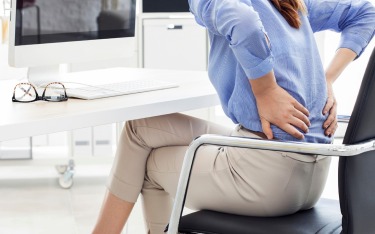
On the bus in the morning, then eight hours at a desk, and on the sofa in the evening: for many of us, most of the day is spent sitting. Because this has become so normal, we hardly realise how much it takes its toll on us. Yet our bodies are built for movement, not for sitting in a chair for hours on end.
What happens to your body when you sit for long periods?
Your muscles switch to ‘energy-saving mode’. Your legs and buttocks – the body’s largest muscle groups – hardly work at all whilst sitting. This reduces energy expenditure, and the body processes sugars and fats less efficiently. In the long term, this increases the risk of type 2 diabetes and cardiovascular disease. If you use your muscles very little, you also gradually lose muscle mass, and this affects your entire metabolism.
Your back and neck are under constant strain. A hunched upper body, eyes fixed on the screen, shoulders hunched forward: this posture puts strain on the spine and often leads to tension and headaches. The intervertebral discs are supplied with nutrients primarily through the alternation of load and relief. If this alternation is absent, they suffer.
Joints need movement. The cartilage in the joints is also nourished by movement. Without it, the cartilage can deteriorate over time, making joint pain more likely.
The cardiovascular system suffers. Studies show that sitting for very long periods is linked to a higher risk of heart problems. The good news is that simply replacing some of your sitting time with movement can significantly reduce this risk.
Your mind takes a hit too. People who sit a lot often feel tired and find it hard to concentrate. Performance tends to dip in the afternoon in particular, even though you’ve done hardly any physical activity. Added to this is an imbalance: your mind is working flat out, whilst your body isn’t being challenged enough. This can lead to stress and a bad mood.

Is one workout after work enough?
Unfortunately, only to a certain extent. Exercise is important and is definitely good for you, but it doesn’t fully compensate for a long period of sitting. What matters is how you spend the rest of the day. If you go for a one-hour run in the morning and then sit for ten hours, you still have a serious problem with sitting for too long.
The World Health Organisation recommends that adults get at least 150 to 300 minutes of moderate exercise per week. It also advises reducing the total amount of time spent sitting. The good news is that every break counts, even a short one.
Five small habits that help in everyday office life
- Get up regularly. Set a timer, for example every hour. Then walk around briefly, fetch some water or do some stretches.
- Take calls whilst standing. It’s worth getting up and moving around for every call.
- Turn meetings into a walk. One-to-one conversations, in particular, often work better outdoors than in a meeting room.
- Change your position. If possible, alternate between sitting and standing whilst working. A height-adjustable desk helps; if necessary, standing on a shelf or a windowsill will do.
- Make the most of your commute. Getting off one stop earlier, cycling or taking the stairs instead of the lift gives you some exercise without having to set aside extra time.
And when working from home?
At home, there’s no commute, and the sofa is never far away. That’s why it’s worth making a conscious effort to create opportunities for movement:
- Deliberately place your glass of water well away from your desk.
- Set aside short breaks during which you walk round the block.
- Replace your commute with a short morning walk. This gives the day some structure.
- Do a few squats, lunges or shoulder circles every now and then. Two minutes is enough.
How to stick with it in the long term
Many resolutions fail because they’re too ambitious. It helps to treat exercise as a fixed appointment, for example by noting it in your diary or arranging to meet up with colleagues. Set yourself goals that you can actually achieve in your day-to-day life. After a few weeks, what initially felt like a struggle usually becomes a routine, and then it gets much easier.
Also, mix up different types of exercise: short, strength-building sessions for your muscles and coordination, combined with some endurance activities such as brisk walking, cycling or swimming. If you prefer a gentler approach, yoga or Pilates are good options.
You don’t need to change jobs or train for hours every day to make a difference. Simply taking regular breaks from sitting and moving around more often in your daily life goes a long way towards benefiting your back, heart and concentration. Start small: at the next opportunity, stand up, stretch and take a few steps. Your body will thank you for it.
Don’t want to miss the next post? SIGN UP FOR OUR NEWSLETTER